

If you live in Maine, Vitamin D deficiency is more common than you might think. This is not a personal failing or a dietary oversight. It is geography. And the consequences reach far beyond bone health. This guide covers what Vitamin D actually does in your body, why living in the Northeast puts you at a real disadvantage, and what you can do about it.
Vitamin D is not really a vitamin
Despite the name, Vitamin D functions more like a hormone than a traditional vitamin. True vitamins must come entirely from food because the body cannot make them. Vitamin D is different. When your skin is exposed to UVB sunlight, your body synthesizes it on its own. From there, it is converted into its active form and travels through your bloodstream, binding to receptors found in nearly every tissue in the body, including your brain, heart, immune cells, gut, and bones.
That is the hallmark of a hormone, not a vitamin. And it matters because it reframes how we think about deficiency. A low Vitamin D level is not just a missing nutrient. It is a disruption in a signaling system that governs dozens of biological processes at once.
Why Vitamin D deficiency in Maine is a geographic problem
Maine sits between roughly 43 and 47 degrees north latitude. That distance from the equator has a direct impact on how much UVB radiation actually reaches us, and for how long each year. From approximately October through April, the sun is at too low an angle in the sky for UVB rays to penetrate the atmosphere effectively. That means even on a clear January afternoon, spending time outside will not raise your Vitamin D levels in any meaningful way.
Add in cold temperatures that keep skin covered, shorter daylight hours, more time spent indoors, and a long winter season that stretches nearly half the year, and the picture becomes clear. Mainers are structurally set up for Vitamin D deficiency in Maine and across the northern United States.
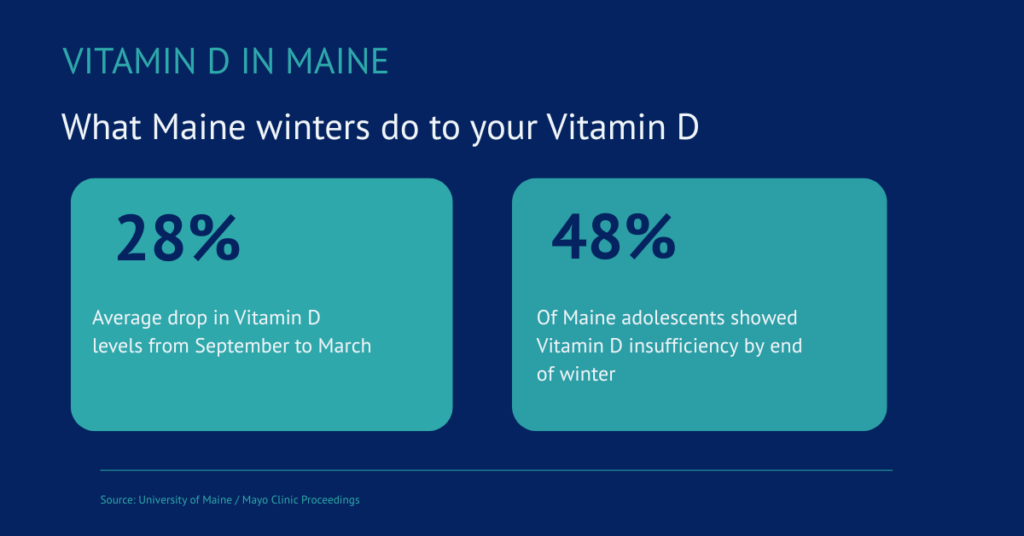
The research backs this up. A University of Maine study found that Vitamin D levels dropped by an average of 28% from September to March in healthy adolescents living in a northern climate. Nearly half of the study participants showed insufficiency by the end of winter. And that was in otherwise healthy young people who were spending time outdoors during the summer months.
Summer sun helps, but it often is not enough to compensate for the deficit built up over the colder months, especially for those who are already starting from a low baseline. This is why consistent testing and supplementation are so important for anyone living in New England.
What low Vitamin D actually does to your health
Vitamin D receptors exist in nearly every cell and tissue in the body. When levels are chronically low, the downstream effects are wide-ranging. Several of the conditions associated with Vitamin D deficiency are also disproportionately common in northern states like Maine, and that overlap is not a coincidence.
How low Vitamin D affects your bones
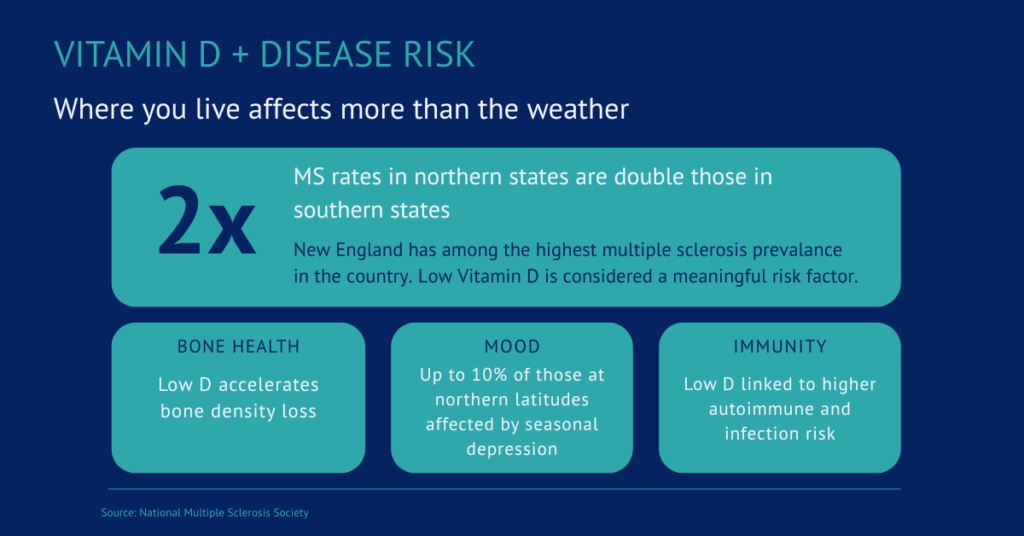
Vitamin D is essential for calcium absorption. Without adequate levels, your body cannot properly absorb the calcium you consume, even if your diet is excellent. Over time, this leads to decreased bone density, increased fracture risk, and in more severe cases, osteomalacia in adults, a softening of the bones that causes pain and muscle weakness. Maine has a higher proportion of older adults than the national average, a population particularly vulnerable to bone loss driven by low Vitamin D.
Multiple sclerosis and low Vitamin D in Maine
The relationship between latitude, sun exposure, and multiple sclerosis is one of the most well-established patterns in neurological research. MS is significantly more common the further you get from the equator. Northern states show MS rates of 110 to 140 cases per 100,000 people, roughly twice the rate seen in southern states. The New England region, including Maine, has among the highest MS prevalence in the entire country according to the National Multiple Sclerosis Society.
Researchers believe that low lifetime Vitamin D levels are a meaningful risk factor for MS development. Low Vitamin D in utero, during childhood, and into adulthood has all been associated with increased risk. While Vitamin D deficiency is not proven to cause MS, the geographic gradient is too strong to ignore.
Seasonal Depression and Low Vitamin D in Maine
Vitamin D plays a direct role in the production of serotonin and dopamine in the central nervous system. When levels drop, so can mood. Research links Vitamin D deficiency to northern depression rates. Seasonal affective disorder impacts 10% of residents, with low D contributing.
Maine winters are long, dark, and isolating in a way that residents know firsthand. The biochemistry behind that familiar winter heaviness is real, and Vitamin D is part of it.
Immune function and autoimmune disease
Vitamin D is a key regulator of immune function. It helps modulate the response of T cells, the immune cells responsible for distinguishing your own tissue from foreign invaders. Low Vitamin D shifts this balance, increasing autoimmune risks like arthritis and lupus while weakening defenses against frequent infections.
Cardiovascular health
Low Vitamin D shifts this balance, increasing autoimmune risks like arthritis and lupus while weakening defenses against frequent infections.
Know your number
The only way to know your Vitamin D status is a blood test measuring 25-hydroxyvitamin D, written as 25(OH)D. Standard lab reference ranges often list anything above 20 ng/mL as sufficient, but many integrative and functional medicine practitioners aim for an optimal range of 60 to 80 ng/mL for overall health and immune support.
Without knowing your level, supplementation becomes a guessing game. And that matters, because both deficiency and excess have real consequences. We encourage patients to get tested before significantly increasing their dose, and to retest after a few months to confirm the approach is working.
Why Vitamin D works better with K2
Vitamin D and Vitamin K2 are nutritional partners, and supplementing one without the other can create an imbalance worth understanding.
- Vitamin D increases your body’s absorption of calcium from food and supplements.
- Vitamin K2 activates proteins that direct that calcium to your bones and teeth, where it belongs.
- Without adequate K2, increased calcium absorption can result in calcium being deposited in soft tissues and arterial walls rather than bone.
This pairing is especially important at higher supplemental doses. Look for K2 in the MK-7 form, the most bioavailable and longest-acting form available.
How to supplement smart
Vitamin D3 (cholecalciferol) is the form your body naturally produces and is significantly more effective than D2 at raising and maintaining blood levels. Look for a clean-label D3 product, ideally paired with K2, and free of unnecessary fillers.
Dosing depends on your current levels, health goals, and individual factors. Common maintenance doses range from 1,000 to 2,000 IU daily, while correcting a deficiency may require higher amounts under appropriate guidance. This is why testing first matters.
Trusted options at Coastal
- Integrative Therapeutics D3 + K2: a well-formulated combination product with clinically relevant doses of both nutrients. Convenient for those who want the pairing in a single capsule.
- Thorne Vitamin D Drops: an excellent liquid option for flexible dosing and easy absorption. Ideal for those who prefer to adjust their dose based on lab results.
- Country Life Vitamin D Softgels: a clean, straightforward D3 option at an accessible price point, great for consistent daily maintenance.
Not sure where to start?
Stop into the store, where our team is happy to help you find the right fit based on your health goals and current levels. We carry several vitamin D formulations, including Vitamin D3 + K2, Vitamin D Drops, and Vitamin D Softgels.