

Walk down any supplement aisle and the choices are overwhelming. Dozens of bottles, all promising to cover your bases, at prices that range from a few dollars to a few times that. So how do you actually choose the right multivitamin?
To choose the right multivitamin, it helps to focus on a few things: matching the formula to where you are in life, understanding the quality of the nutrients inside, and knowing what you can safely skip. Here is how we walk clients through it.
Start with what a multivitamin is for
A multi is meant to fill the small, everyday gaps in a well-rounded diet. It is not a replacement for food, and it is not a treatment for a specific deficiency. If you already eat a varied diet, the goal is steady, foundational coverage rather than mega-doses of everything.
This matters because more is not always better. Some nutrients, especially fat-soluble vitamins (vitamins that are stored in fat tissue) like A, D, E, and K and minerals like iron, can build up or cause problems in excess. A well-designed multi delivers sensible amounts, not the highest number it can fit on the label.
Choosing the right multivitamin for your phase of life
Your needs shift over time, and part of learning to choose the right multivitamin is accounting for those shifts. A few general guideposts:
| Life Stage | Priority Shift |
|---|---|
| Foundational adult | If you are a healthy adult without specific concerns, a well-rounded general formula is often all you need. This is also a practical choice for a household that wants one bottle that works for most people. |
| Women in the reproductive years | Formulas for this stage often include extra support for the demands of menstruation and bone health. Iron may be included, which is appropriate for many premenopausal women but not for everyone. |
| Women in perimenopause, menopause, and beyond | After about age 45, priorities shift toward bone and heart health. Look for formulas that emphasize these, often with added vitamin K2, vitamin D, and antioxidants. Iron needs typically drop after menopause, so many formulas for this stage leave it out or keep it low. |
| Men | Men generally need little to no supplemental iron, so quality men’s formulas usually skip it. Many add nutrients that support prostate and cardiovascular health. |
| Men in mid-life | Priorities shift toward heart health, prostate support, cellular energy, and metabolic vitality. Look for formulas featuring activated B-vitamins, antioxidants like lycopene, zinc, and vitamin D3/K2. Supplemental iron is almost always omitted. |
| Pregnancy and nursing | A prenatal is its own category. The priorities are folate for early development, adequate iron, choline, and often DHA. If you are planning a pregnancy, starting a quality prenatal before you conceive is one of the most worthwhile steps you can take. |
| Older adults (general) | Needs often shift again later in life, with more attention to B12, vitamin D, and forms that are easy to absorb and gentle on digestion. |
Read the label: the forms matter as much as the names
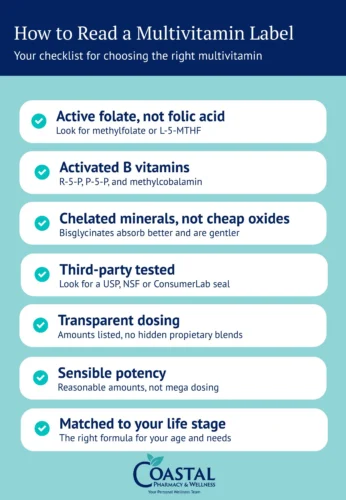
This is the part most people miss. Two multivitamins can list the exact same vitamins and minerals and still perform very differently, because your body absorbs and uses some forms far better than others. When you compare bottles to choose the right multivitamin, look past the names to the forms in the ingredient list.
B Vitamins
Many multis use synthetic folic acid, which the body has to convert before it can use it. A significant portion of people carry common genetic variations, like the MTHFR gene, that make conversion less efficient. An already-active form, listed as methylfolate or L-5-MTHF, is ready to use regardless of how well you convert.
To skip the conversion step, look for activated (or coenzymated) forms of these B vitamins so you get the same forms your cells use.
| Vitamin | Activated Form |
|---|---|
| Folate (B9) | Methylfolate or L-5-MTHF |
| Riboflavin (B2) | R-5-P |
| B6 | P-5-P |
| B12 | Methylcobalamin |
Minerals
This is where cheaper products cut corners. Minerals can be delivered as inexpensive salts like oxides and carbonates, which tend to be poorly absorbed and can be harsh on digestion, or as amino-acid chelates such as bisglycinates, where the mineral is bound to an amino acid for better absorption and a gentler effect on the gut. If iron is included, a chelated or gentle form is much easier to tolerate.
As a rule of thumb: active vitamin forms and chelated minerals signal a formula designed to be used, not just to look complete on paper.
| Common Mineral Salts | How Well it Absorbs |
|---|---|
| Oxides | Poorly absorbed and can be harsh on digestion. Common in budget formulas. |
| Carbonates | Somewhat better than oxides, but still not well absorbed by many people. |
| Bisglycinates | Well absorbed and gentle on the stomach. This is the form to look for. |
For more information on chelated minerals, see Chelated Minerals: Getting the Most Out of Your Mineral Supplement.
More ways to choose the right multivitamin
Beyond the forms, a few things separate a considered formula from a filler-heavy one:
Third-party testing. Independent verification, from programs like USP, NSF, or ConsumerLab, confirms that what is on the label is actually in the bottle and free of contaminants. This is especially worth checking with supplements, which are not tightly regulated before they reach the shelf.
Clean, minimal additives. Fewer unnecessary fillers, dyes, and binders is generally better.
Transparent dosing. Be cautious with proprietary blends that list a total weight but hide how much of each ingredient you are getting. You want to see the amounts.
Sensible potency. Very high doses of everything are a marketing signal more than a health one. Amounts in a reasonable range are a sign of a thoughtful formula.
When you want a more personalized answer
A quality multivitamin is a foundation, not a full picture of your health. If you are managing specific concerns, taking other medications, or simply not sure whether your current routine is meeting your needs, it is worth getting a second set of eyes on it.
We are happy to help you think it through. We do not diagnose or prescribe. What we do is look at how your supplements, diet, and goals fit together, help you compare specific products, and coordinate with your primary provider so everything works as one plan. Consultations are available in person and by telehealth.
This information is for educational purposes and is not intended to diagnose, treat, cure, or prevent any disease. Talk with your healthcare provider before starting a new supplement, especially if you are pregnant, nursing, or taking medication.