

Vaginal dryness after menopause is one of the most common changes women notice, along with itching, burning, discomfort with intimacy, and more frequent urinary symptoms. These changes can begin in perimenopause (the transition years before your final period, often starting in your 40s) and tend to continue into postmenopause (the years after 12 months without a period). Research estimates they affect between 27% and 84% of postmenopausal women, yet they often go untreated.
The clinical name for this group of symptoms is genitourinary syndrome of menopause (GSM). You may also hear the older term vaginal atrophy. As estrogen declines, the tissue of the vagina, vulva, and lower urinary tract becomes thinner, less elastic, and less able to hold moisture. Vaginal pH rises and protective bacteria decrease, which helps explain why urinary tract infections can become more frequent after menopause. Unlike hot flashes, which often ease with time, these symptoms tend to persist without treatment.
The good news: vaginal dryness after menopause is treatable, and many effective options are hormone-free.
What Changes After Menopause?
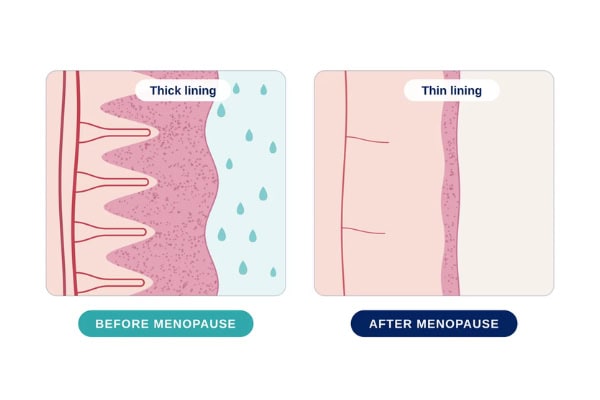
As estrogen declines, the vaginal lining becomes thinner, drier, and less elastic, with reduced blood flow. This is why vaginal dryness after menopause is so common, and why restoring moisture can help.
First steps for vaginal dryness after menopause: moisturizers and lubricants
Over-the-counter products are the usual first step, and they are appropriate for nearly everyone, including women who cannot or prefer not to use hormones. It helps to know the difference between the two types:
- Lubricants are used at the time of intimacy to reduce friction and discomfort. Relief is short-term. Good Clean Love Almost Naked is a water-based option we carry.
- Moisturizers are used regularly, typically every few days, to keep tissue hydrated between uses. Emerita Personal Moisturizer and Vmagic are two options on our shelves. Vmagic is a balm made with oils, which many women find longer lasting for external dryness. Oil-based products can weaken latex condoms.
When choosing a product, we generally suggest fragrance-free formulas and avoiding warming or tingling additives, which can irritate sensitive tissue. Pelvic floor physical therapy can also help when discomfort with intimacy or urinary symptoms are part of the picture.
Hyaluronic acid for vaginal dryness after menopause
When moisturizers alone are not enough, vaginal hyaluronic acid is one of the better-studied non-hormonal options. Hyaluronic acid is a molecule our bodies already make that holds onto water, which helps hydrate dry tissue. It is sometimes combined with vitamins A and E, which support the health of the skin and mucous membranes.
What the research shows so far:
- In an open trial of 150 postmenopausal women, a vaginal suppository containing hyaluronic acid, vitamin A, and vitamin E (used nightly for two weeks, then every other night for two weeks) improved vaginal dryness and related symptoms, with no adverse effects reported. This study had no comparison group, so the results are encouraging but preliminary.
- In a randomized trial of 56 women, a hyaluronic acid vaginal cream was compared with a conjugated estrogen cream (Premarin) over eight weeks. Both groups improved, and the hyaluronic acid group reported similar or greater relief of dryness, itching, and pain with intercourse.
These studies are small and short, and vaginal estrogen remains the most studied treatment. Still, hyaluronic acid is a reasonable, well-tolerated choice for women who need or prefer to avoid hormones.
Hyaluronic acid vaginal products are available over the counter. As a compounding pharmacy, we can also prepare a hyaluronic acid suppository with vitamins A and E with a prescription from your provider, which lets us adjust the base and strength for your needs.
Prescription options for vaginal dryness after menopause
For moderate to severe symptoms, or when over-the-counter options are not enough, your provider may suggest one of these:
- Low-dose vaginal estrogen (cream, insert, or ring) is considered the most effective treatment for GSM. Very little is absorbed into the bloodstream. In 2025, the FDA began removing the boxed warnings about heart disease, breast cancer, and dementia from estrogen labels, including vaginal products, after reviewing the current evidence. Major medical societies also agree that women with a uterus generally do not need to add progesterone when using low-dose vaginal estrogen. Compounded estradiol or estriol creams are another option when a custom strength or base is needed.
- Vaginal DHEA is a nightly insert that the vaginal tissue converts locally into estrogen and androgens.
- Ospemifene is a non-estrogen oral tablet that acts on vaginal tissue to reduce pain with intercourse and dryness. It is not a fit for everyone, so your provider will review your health history first.
If you have a history of breast cancer
Non-hormonal options are the starting point for breast cancer survivors. When those are not enough, both the American College of Obstetricians and Gynecologists and The Menopause Society support considering low-dose vaginal estrogen in partnership with your oncologist. Women taking aromatase inhibitors often have the most severe symptoms and need the most individualized plan. A family history of cancer is different from a personal history and is worth talking through with your provider rather than assuming hormones are off the table.
How we can help
Vaginal dryness after menopause is common, but it is not something you have to live with. Our pharmacists can walk you through over-the-counter products, explain how compounded options work, and coordinate with your provider, who makes the final treatment decisions. Stop by the pharmacy or book a hormone consult to talk through what may fit you best.
References
- The 2020 genitourinary syndrome of menopause position statement of The North American Menopause Society. Menopause. 2020;27(9):976-992. https://pubmed.ncbi.nlm.nih.gov/32852449/
- American College of Obstetricians and Gynecologists. Treatment of urogenital symptoms in individuals with a history of estrogen-dependent breast cancer: Clinical Consensus No. 2. Obstet Gynecol. 2021;138(6):950-960. https://pubmed.ncbi.nlm.nih.gov/34794166/
- American Urological Association, Society of Urodynamics, Female Pelvic Medicine and Urogenital Reconstruction, American Urogynecologic Society. Genitourinary Syndrome of Menopause: AUA/SUFU/AUGS Guideline. 2025. https://www.auanet.org/guidelines-and-quality/guidelines/genitourinary-syndrome-of-menopause
- U.S. Food and Drug Administration. FDA requests labeling changes related to safety information to clarify the benefit/risk considerations for menopausal hormone therapies. November 10, 2025. https://www.fda.gov/drugs/drug-safety-and-availability/fda-requests-labeling-changes-related-safety-information-clarify-benefitrisk-considerations
- Costantino D, Guaraldi C. Effectiveness and safety of vaginal suppositories for the treatment of the vaginal atrophy in postmenopausal women: an open, non-controlled clinical trial. Eur Rev Med Pharmacol Sci. 2008;12(6):411-416. https://pubmed.ncbi.nlm.nih.gov/19146203/
- Jokar A, Davari T, Asadi N, et al. Comparison of the hyaluronic acid vaginal cream and conjugated estrogen used in treatment of vaginal atrophy of menopause women: a randomized controlled clinical trial. Int J Community Based Nurs Midwifery. 2016;4(1):69-78. https://pmc.ncbi.nlm.nih.gov/articles/PMC4709811/