
Hydroxyapatite toothpaste is a well-studied, fluoride-free option that performed about as well as fluoride toothpaste for cavity prevention in recent trials, and it shows real promise for sensitive teeth. It is not yet FDA-recognized as an anticavity ingredient in the U.S., and fluoride still has far more long-term data behind it.
We get asked about this one a lot at the counter. Fluoride has been in the news over the past year, more “mineral” and “biomimetic” toothpastes are showing up on shelves, and many of our customers simply want to know whether the switch is worth it. Below, we walk through what hydroxyapatite is, what the research actually shows, and who might consider it.
What is hydroxyapatite?
Hydroxyapatite (HAp) is a calcium phosphate mineral and the main inorganic building block of tooth enamel and bone. The toothpaste version uses a synthetic form of that same mineral [1, 7].
The idea is not new. NASA researchers explored synthetic hydroxyapatite for tooth and bone repair in the 1970s, a Japanese company licensed the technology, and Japan approved hydroxyapatite as an anticavity ingredient in 1993 [1, 8]. It has been a mainstream toothpaste ingredient there for decades.
You will see two forms on labels:
- Micro-hydroxyapatite (mHAp): larger, micron-sized particles.
- Nano-hydroxyapatite (nHAp): particles under roughly 100 nanometers. Most newer U.S. brands use this form [8].
Both forms have been tested in clinical trials. The particle size matters more for safety review and marketing than it does for choosing between brands, as long as the product discloses what it uses.
How it works
Hydroxyapatite works by supplying the same mineral enamel is made of, so it can deposit into early weak spots rather than changing the enamel’s chemistry. Every day, acids from food and oral bacteria pull calcium and phosphate out of enamel, and saliva works to put them back. When loss outpaces repair, early cavities begin.
- Fluoride helps by converting the enamel surface into fluorapatite, a more acid-resistant mineral, and by encouraging remineralization.
- Hydroxyapatite particles bind to the tooth surface, fill microscopic defects, and act as a reservoir of calcium and phosphate. Lab and in-mouth (in situ) studies show it can remineralize early lesions, and some suggest it reaches below the surface layer [1, 7]. It also appears to reduce how well bacteria stick to teeth [3].
The two are not mutually exclusive. Some products combine them, which we touch on below.
Does it prevent cavities?
In head-to-head trials, fluoride-free hydroxyapatite toothpaste was “non-inferior” to fluoride toothpaste, meaning it performed within a preset margin of fluoride rather than proving better or worse. The key studies:
| Study | Participants | Length | Result |
|---|---|---|---|
| Paszynska et al., 2023 [2] | 171 adults, ages 18 to 45 | 18 months | No new decay in 89.3% of the HAp group vs 87.4% of the fluoride (1,450 ppm) group |
| Paszynska et al., 2021 [1] | 207 children, ages 3 to 7 | About 1 year | Early enamel caries progressed in 72.7% (HAp) vs 74.2% (fluoride) of children |
| Limeback et al., 2024 meta-analysis [3] | 5 clinical trials + 8 in situ studies | Pooled | HAp toothpastes as effective as fluoride for caries prevention |
This is encouraging, and it is also a young evidence base. A few things we want you to know:
- The numbers are small. Fluoride’s track record comes from decades of trials covering tens of thousands of people. Hydroxyapatite has a handful of modern trials in the hundreds.
- Industry involvement is common. Several of the key trials and reviews were funded by or co-authored with hydroxyapatite toothpaste manufacturers. That does not make them wrong, but independent replication matters.
- “Non-inferior” is not “better.” These trials were designed to show hydroxyapatite is not meaningfully worse than fluoride, which is a reasonable goal for an alternative.
That is why many dentists still describe fluoride as the standard of care, while viewing hydroxyapatite as a reasonable option for people who prefer to avoid fluoride [8].
What about sensitive teeth?
Sensitivity is where hydroxyapatite has some of its strongest data. Sensitivity happens when exposed dentin lets hot, cold, or air reach the nerve through tiny tubules. Hydroxyapatite particles can plug those tubules.
- A 2019 meta-analysis of randomized trials found nano-hydroxyapatite products relieved sensitivity more than placebo or other desensitizing treatments for air and touch triggers, though not for cold. The authors called for longer trials before firm recommendations [4].
- An 8-week randomized trial at UT Health San Antonio found nano-hydroxyapatite toothpastes worked about as well as a leading sensitivity toothpaste [5].
In short, if sensitivity is your main concern, hydroxyapatite is a reasonable product to try, and results usually show within about four weeks of consistent use. Sudden or worsening sensitivity is worth a dental visit, since it can signal a cavity, a cracked tooth, or gum recession.
Is it safe?
The research so far suggests hydroxyapatite toothpaste is safe when used as directed [8]. Because it is the same mineral our teeth and bones are made of, swallowing small amounts is not linked to fluorosis or other systemic risks, which is one reason it is often discussed for young children who have not mastered spitting [1, 3].
The main question people raise is about nano-sized particles. The European Union’s Scientific Committee on Consumer Safety (SCCS) reviewed this most recently in 2025 and concluded that nano-hydroxyapatite is safe in toothpaste at concentrations up to 29.5% [6]. In that review:
- Uptake through the lining of the mouth was considered negligible.
- Any particles swallowed dissolve quickly in stomach acid.
- The opinion applies only to rod-shaped, uncoated particles. Needle-shaped particles were excluded and are not considered safe under that review.
U.S. regulators have not published a comparable ingredient-specific review, so the EU opinion is the most detailed safety assessment available. It is also a good reason to choose brands that are transparent about their particle form.
Why your dentist may not recommend it (yet)
In the U.S., hydroxyapatite is not an FDA-recognized anticavity ingredient, and no hydroxyapatite toothpaste carries the American Dental Association (ADA) Seal of Acceptance [9]. That is largely a regulatory gap rather than a safety finding:
- The FDA’s over-the-counter anticavity rules list only fluoride ingredients, so a hydroxyapatite toothpaste cannot legally say “anticavity” or “prevents cavities” on the tube.
- The ADA Seal for cavity protection requires fluoride [8].
- Other countries have gone further. Japan has recognized hydroxyapatite as an anticavity agent since 1993 [1].
The ADA continues to recommend fluoride as safe and effective, while acknowledging that alternatives like hydroxyapatite may be offered to patients who are well informed about the differences in evidence [9]. We think that is a fair way to frame it.
Who might consider it?
Hydroxyapatite makes the most sense for people who have a specific reason to look beyond standard fluoride toothpaste. Examples include:
- People who prefer to avoid fluoride. It is currently the most researched fluoride-free option for cavity prevention.
- Families with young children who tend to swallow toothpaste, after a conversation with their pediatric dentist.
- People with sensitive teeth, where the evidence is relatively strong.
- People with dry mouth. Saliva is the mouth’s natural remineralizer, and dry mouth is common with age and with many medications, including some for blood pressure, mood, sleep, and allergies. Hydroxyapatite is of interest here, though the support so far is mostly from lab studies, so it should complement, not replace, any plan from your dentist.
You do not have to choose one or the other. Some toothpastes combine hydroxyapatite with fluoride, and some people use a fluoride toothpaste at one brushing and hydroxyapatite at the other. A 2-year trial in children found a hydroxyapatite-plus-fluoride paste may work better than fluoride alone for active early cavities [10].
If you are at high risk for cavities, have frequent fillings, wear braces, or use a prescription-strength fluoride toothpaste, talk with your dentist before making any change.
How to choose a hydroxyapatite toothpaste
Because these products are sold as cosmetics in the U.S., quality and transparency vary. A few things we look for:
- A disclosed concentration. Many of the clinical trials used around 10% hydroxyapatite. Products that list “hydroxyapatite” far down the ingredient list, with no percentage, may contain very little.
- The particle form. Micro or nano are both fine. Brands that state their particles are rod-shaped or non-needle-shaped are aligning with the EU safety review.
- A simple, gentle formula. Low abrasiveness matters if you have sensitivity or gum recession.
- Realistic claims. Be cautious of products promising to “regrow enamel” or “reverse cavities.” Hydroxyapatite can help remineralize early weak spots, but no toothpaste repairs a true cavity.
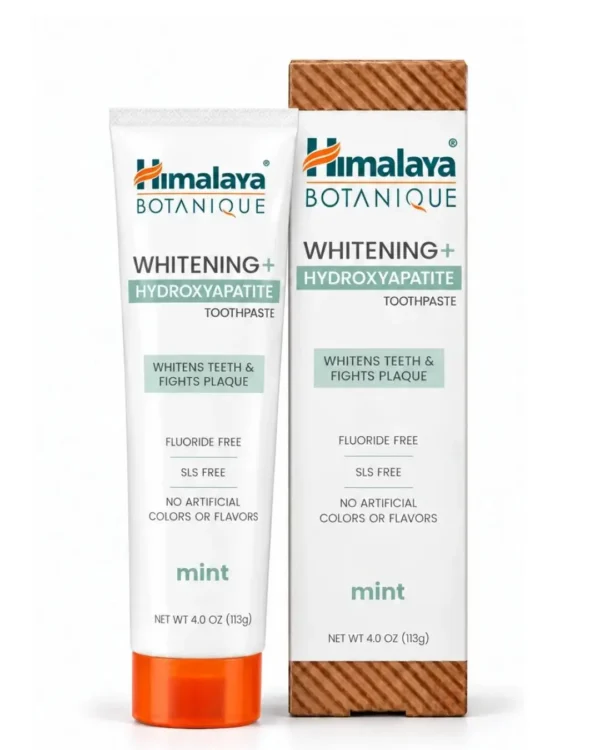
How you use it matters too. Brush twice daily for two minutes, spit rather than rinse, and follow the product’s directions. Some brands suggest waiting 30 minutes before eating or drinking.
The bottom line
Hydroxyapatite toothpaste is a safe, evidence-backed option, especially for people who want to avoid fluoride or who struggle with sensitivity. Early trials suggest it holds its own against fluoride for cavity prevention, but the research is newer and smaller, and fluoride remains the most thoroughly proven choice. For most people with healthy teeth, there is no urgent reason to switch. For others, it can be a thoughtful fit.
As with any change to your routine, we recommend looping in your dentist, especially if you have a history of cavities, dry mouth, or other dental concerns.
Have questions about which toothpaste fits your needs, or wondering whether one of your medications could be contributing to dry mouth? Stop by Coastal Pharmacy & Wellness at 29 Marginal Way in Portland or call us at 207-899-0993. Our staff is happy to help you sort through the options.
This article is for educational purposes and is not a substitute for individual advice from your dentist or healthcare provider.
References
- Paszynska E, et al. Impact of a toothpaste with microcrystalline hydroxyapatite on the occurrence of early childhood caries: a 1-year randomized clinical trial. Sci Rep. 2021;11:2650.
- Paszynska E, et al. Caries-preventing effect of a hydroxyapatite-toothpaste in adults: a 18-month double-blinded randomized clinical trial. Front Public Health. 2023;11:1199728.
- Limeback H, et al. Clinical evidence of caries prevention by hydroxyapatite: an updated systematic review and meta-analysis. J Dent. 2024;151:105429.
- de Melo Alencar C, et al. Clinical efficacy of nano-hydroxyapatite in dentin hypersensitivity: a systematic review and meta-analysis. J Dent. 2019;82:11-21.
- Amaechi BT, et al. Clinical efficacy of nanohydroxyapatite-containing toothpaste at relieving dentin hypersensitivity: an 8 weeks randomized control trial. BDJ Open. 2021;7:23.
- Scientific Committee on Consumer Safety. Opinion on Hydroxyapatite (nano), Submission IV (SCCS/1677/25). Final version adopted June 26, 2025.
- O’Hagan-Wong K, et al. The use of hydroxyapatite toothpaste to prevent dental caries. Odontology. 2022.
- MUSC Health. Brushing up on hydroxyapatite toothpaste with an MUSC Health dentist. July 24, 2026.
- Dimensions of Dental Hygiene. Hydroxyapatite offers a new option in caries prevention and sensitivity relief.
- Hydroxyapatite-fluoride toothpastes on caries activity: a triple-blind randomized clinical trial. Int Dent J. 2025.